Learning Outcomes:
i. Describe the reactions of Group II elements with water, oxygen, and nitrogen.
ii. Explain the reactivity trends of Group II elements based on their electron configurations and ionization energies.
iii. Analyze the role of electron configurations in determining the type of bonds formed during the reactions of Group II elements.
iv. Apply the concept of oxidation states to predict the products of reactions between Group II elements and various reagents.
Introduction:
Group II elements, also known as alkaline earth metals, are characterized by their unique electron configurations and moderate reactivity. In this final lesson, we will explore the reactions of Group II elements with water, oxygen, and nitrogen, completing our understanding of their chemical behavior.
i. Reactions with Water:
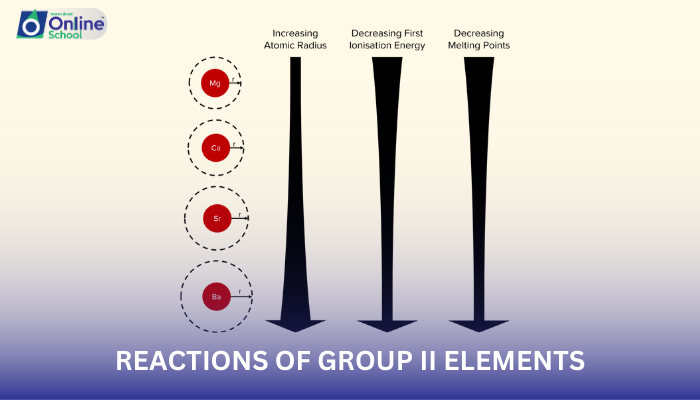
Group II elements react with water less vigorously than Group I elements due to their higher ionization energies and smaller electron sizes. The reactivity increases down the group due to decreasing ionization energy and increasing electron size, which lead to easier electron loss and more intense reactions.
Beryllium (Be): Be(s) + 2H2O(l) → Be(OH)2(aq) + H2(g) (very slow)
Magnesium (Mg): Mg(s) + 2H2O(l) → Mg(OH)2(s) + H2(g) (moderate)
Calcium (Ca): Ca(s) + 2H2O(l) → Ca(OH)2(s) + H2(g) (fast)
ii. Reactions with Oxygen:
Group II elements react with oxygen to form oxides. The reactivity increases down the group due to the same factors as their reactivity with water.
Beryllium (Be): Be(s) + O2(g) → BeO(s)
Magnesium (Mg): Mg(s) + O2(g) → MgO(s)
Calcium (Ca): Ca(s) + O2(g) → CaO(s)
iii. Reactions with Nitrogen:
Group II elements react with nitrogen to form nitrides. The reactivity increases down the group due to the same factors as their reactivity with water.
Beryllium (Be): Be(s) + N2(g) → Be3N2(s)
Magnesium (Mg): Mg(s) + N2(g) → Mg3N2(s)
Calcium (Ca): Ca(s) + N2(g) → Ca3N2(s)
iv. Reactivity Trends:
The reactivity of Group II elements with water, oxygen, and nitrogen increases down the group due to decreasing ionization energy and increasing electron size. This trend can be explained by the concept of electron shielding. As we move down the group, the outer electrons are increasingly shielded from the nucleus by the inner electrons, making them easier to remove and participate in chemical reactions.
v. Bond Formation:
The reactions of Group II elements with water, oxygen, and nitrogen involve the formation of ionic bonds, similar to Group I elements. Ionic bonds are formed between atoms with significantly different electronegativities. In these reactions, the Group II element loses its two valence electrons to the nonmetal, resulting in the formation of positively charged ions (cations) and negatively charged ions (anions).
vi. Oxidation States:
Group II elements consistently exhibit an oxidation state of +2 in their compounds. This is because they readily lose their two valence electrons to achieve a stable noble gas electron configuration.
The reactions of Group II elements with water, oxygen, and nitrogen provide insights into their moderate reactivity and chemical behavior. Understanding the reactivity trends and the role of electron configurations and electron shielding effects allows us to predict the products of reactions involving these elements. By comprehending these reactions, we gain a deeper appreciation of the chemistry of Group II elements and their applications in various fields.
